

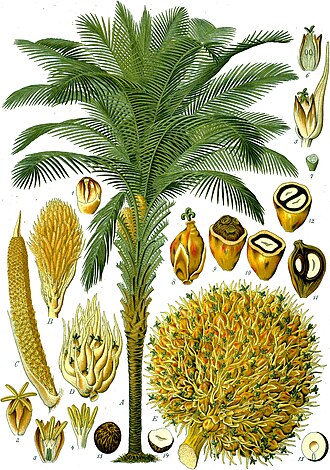
ELAEIS GUINEENSIS
ARECACEAE
Apart from the coconut tree, COCOS NUCIFERA, the most important palm tree as a cultivated plant is the African oil palm, ELAEIS GUINEENSIS, which is currently the world’s leading oilseed crop.
Many palm trees are very useful plants because of their oily fruits (pulp and kernel), their useful and sometimes medicinal leaves, their sap, their edible buds (palm heart), and their wood.
On this page, we will primarily discuss the African oil palm, valued for its edible oils and medicinal leaves.
The oil palm, Elaeis oleifera, originates from the coastal regions of West Africa (specifically the Gulf of Guinea), but it is also found further inland in tropical and equatorial Africa.
Natural Elaeis oleifera palm groves exist in Africa.
This palm can reach over 20 meters in height in its natural habitat, but in plantations, it cannot be harvested once it exceeds 15 meters. Unlike the coconut palm, it is not easy to climb an oil palm because the fronds are protected by sharp spines!
COMPOSITION AND PROPERTIES
THE FRUIT OF THE OIL PALM, ELAEIS GUINEENSIS
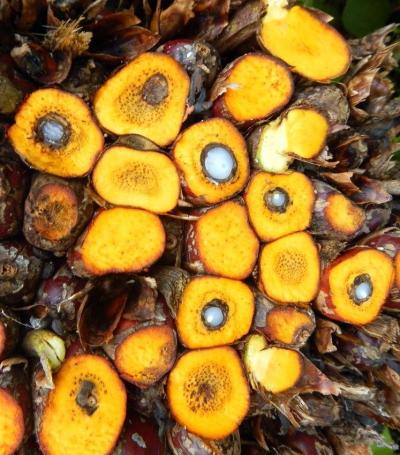
Cutting of the fruit of the oil palm
The fruit of the oil palm is a drupe (a fleshy fruit containing a pit), varying in color from yellow to orange, sometimes red or black.
The fruits grow in very dense bunches, their number varying depending on growing conditions, the tree’s genetics, its age, etc. There can be anywhere from a few hundred to several thousand drupes. A bunch can weigh up to 50 kg in the best cases.
The palm can produce fruit year-round when growing conditions are favorable.
The larger the tree grows, the more difficult harvesting becomes, and as it ages, the palm can become exhausted and is eventually abandoned or felled.
The genetics of the oil palm result in three types of fruit: a variety with a hard kernel, a variety with a much thinner shell, and a shell-less (but sterile) variety. Wild varieties are of the hard kernel type (dura variety). Cultivated varieties are most often thin-shelled (tenera variety), with fruits rich in pulp and kernels that are easier to crush.
Like many large trees in tropical rainforests, the flowers of the oil palm are primarily pollinated by animals, and in the case of this palm, it is Elaeidobius kamerunicus, a small weevil native to tropical Africa, that is the main pollinating insect of the oil palm (Elaeis guineensis). Without it, pollination, and therefore fruit production, is significantly reduced. It has thus been successfully introduced to the Indo-Malayan region, where palm groves are numerous and extensive.
CHEMICAL COMPOSITION OF THE PULP OF THE FRUIT OF ELAEIS GUINEENSIS, THE GUINEA OIL PALM
100 grams of oil palm fruit pulp contain approximately 4 grams of protein, 6 grams of carbohydrates, and 33 grams of fat, providing about 350 kcal. It is therefore a very nutritious fruit.
It contains carotenoids (antioxidant pro-vitamin A) which color the crude oil reddish-orange, and a chemical similar to vitamin E (tocotrienols).
The pulp of the fresh fruit contains 40 to 55% fat. The oil yield of the whole fruit is approximately 20 to 25% of the total weight of the fruit bunch.
AVERAGE COMPOSITION OF FATTY ACIDS IN PALM OIL FROM THE PULP
Palmitic acid 44%,
oleic acid 39%,
linoleic acid 11%,
stearic acid 5% ,
myristic acid 1%
Therefore, it’s half unsaturated fatty acids, half saturated fatty acids.
This makes it a somewhat unbalanced oil from a nutritional standpoint, but it is resistant to oxidation (it keeps well and can be heated) and remains liquid at room temperature.
Crude oil, colored yellow-orange or red, contains carotenoids (provitamin A) and tocotrienols (vitamin E), but refined oil is virtually devoid of these.
THE ALMOND (KERNEL) OF THE FRUIT OF THE OIL PALM
The kernel of the oil palm fruit is relatively small; the ‘dura’ variety has a shell that is difficult to crack, while the ‘tenera’ variety has a thinner shell.
The kernel is edible and contains approximately 45 to 50% lipids.
A palm kernel oil, which differs in composition from palm oil and is similar in composition to coconut oil, is extracted from it by pressing and crushing.
AVERAGE COMPOSITION OF FATTY ACIDS IN PALM KERNEL OIL:
Lauric acid 40 to 45%
Myristic acid 15 to 17%
Oleic acid 14 to 17%
Palmitic acid 7 to 10%
Capric acid 3 to 5%
Stearic acid 2 to 4%
Linoleic acid 1 to 3%
It is therefore an edible oil of the « lauric » type, containing mainly saturated fatty acids and very few unsaturated fatty acids (oleic and linoleic). As a result, it is very resistant to rancidity and can withstand cooking, but it is not at all balanced from a nutritional point of view. It is semi-liquid below 20 to 25°C.
Crude palm kernel oil is pale yellow because it contains few carotenoid pigments, as well as a small amount of tocotrienols and α-tocopherol (vitamin E); refined oil is colorless.
OIL PALM LEAVES
Palm leaves are abundant and sometimes used by traditional healers.
The pharmacologically active substances in these palm fronds are primarily phenolic compounds soluble in water and ethanol: tannins and flavonoids known for their antibacterial, anti-inflammatory, and antidiarrheal properties, as well as their ability to dry mucous membranes or wounds, and their potential antidiabetic effects.
The palm fronds can also be crushed to extract a juice considered anti-infective, healing, and soothing to diarrhea (but very astringent).
THE SAP OF THE OIL PALM
It is not very easy to obtain but has medicinal properties (laxative) and can be drunk diluted or fermented (palm wine and distilled alcohol).
PALM HEART OR PALM CABBAGE
The terminal bud, which weighs several kilograms and is edible raw, can be extracted from felled palm trees (for example, those too tall to be harvested). It provides vitamins, carbohydrates, tannins, and fiber.
USES
These large palm trees native to Africa are best known for their oil, which is used universally in the food industry, but the leaves possess some interesting pharmacological properties.
PALM OIL
Palm oil is the most consumed oil in the world, used in the form of oil or margarine, or in the manufacture of so-called « processed » foods, often as a replacement for other, more expensive or less convenient fats in the food industry (animal fats such as lard or butter, and other more expensive or less chemically stable vegetable oils).
It is therefore found in everything from freeze-dried soups to spreads, prepared meals, cheeses, savory and sweet biscuits, brioches, and industrial bread, etc. Its presence is often difficult to detect in the ingredient list (generally under the generic term « vegetable oil »).
It is also an « industrial » oil, used to make soaps (sodium palmate) and can also be transformed into a fuel to replace diesel (biofuel).
Palm oil was a component of napalm, a now-banned incendiary weapon.
In producing countries, you can find « crude » or minimally refined oil, which still contains carotenoids (provitamin A) and vitamin E analogues. It is then a rich yellow-orange color, sometimes with a hint of red. This oil is good for cooking, but it contains few unsaturated fats, so it’s also necessary to consume almonds, walnuts, or oily fish, or mix it with another vegetable oil (rapeseed, sunflower, corn, peanut, wheat germ, etc.).
PALM KERNEL OIL
Palm kernel oil is most often extracted chemically (using hexane). Its composition is similar to coconut oil, a commonly consumed oil that becomes semi-solid when the temperature drops below 20°C. It is chemically stable and perfectly edible, but other unsaturated fats (fish, nuts, other polyunsaturated vegetable oils) should be added to the diet.
It is an oil of interest for its cosmetic properties, protecting the skin and nourishing hair and nails.
OIL PALM LEAVES
Palm fronds can be used for medicinal purposes because, like many leaves, they contain phenolic compounds that are potentially anti-infectious, antioxidant, and drying inflamed mucous membranes.
They can be used:
– the juice extracted by pressing crushed or ground palms in local care: wounds, burns, ulcers, mouth care (gingivitis, canker sore, dental infection in association with an essential oil such as clove for example).
– An aqueous infusion/decoction of palm leaflets: a handful of palm leaves in 1/2 liter of water, boil for one minute (for an infusion) and 5 to 10 minutes for a decoction (more concentrated).
– To treat type 2 diabetes (one cup of infusion twice a day in addition to a low-calorie diet),
– three cups of infusion per day to calm diarrhea (without fever).
– The decoction can be used to wash a soiled wound, a burn, or a weeping ulcer, as a gargle or mouthwash in case of inflammation or infection of the mouth or throat when more appropriate medications are unavailable. It is a good healing agent.
The decoction is very astringent; avoid swallowing it.
ORIGIN AND CULTURE OF THE ELAEIS OLEIFERA OIL PALM TREE
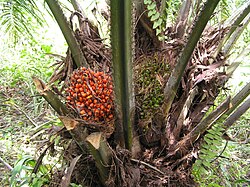
The oil palm Elaeis oleifera, native to the coastal regions of West Africa, is now cultivated and widespread in many tropical and equatorial regions. « Industrial » plantations are found mainly in Malaysia, Indonesia, and Papua New Guinea.
The industrial development of these plantations has led to an ecological disaster because older plantations (25 to 30 years old) become unproductive or difficult to manage, and new areas of pristine tropical and equatorial forest are then deforested to establish new palm groves, to the detriment of biodiversity and wildlife, particularly the last remaining Asian great apes (orangutans).
Despite the industrialization of these plantations, the harvesting of the fruit bunches is most often done manually.
The bunches are generally cut from the ground when they are ripe.
According to CIRAD: « The best yields are obtained on deep soils. They require 2000 hours of sunshine per year, more than 1800 mm of rain well distributed throughout the year, average temperatures of 28 °C, minimum temperatures above 20 °C and humidity above 60%.
Whether family-run or agro-industrial, plantations must obtain selected seeds from accredited institutions: to plant one hectare with 143 palm trees, 200 germinated seeds must be ordered.
Fertilization represents a significant expense in operating costs, but it is essential to optimize production and maintain plantation fertility.
Intercropping with food crops – maize, cassava, plantain, yam, rice, peanuts, okra, chili peppers… – is common on family farms during the first 2 or 3 unproductive years of the oil palm, when its size is still small. »
The palm oil and palm kernel trade is flourishing, global demand for oilseeds is steadily increasing, some South American countries already have large plantations (Colombia, Brazil) and the Philippines, where the coconut tree is king, are also launching government-supported oil palm plantation projects.
SOME OTHER OIL PALM TREES
The coconut tree, COCOS NUCIFERA , is very widespread in tropical and equatorial regions; its cultivation is easy and ecologically acceptable; it is content with soil that is sometimes shallow and close to the sea; coconut groves are renewable, like a normal crop, when the trees become too old and therefore unproductive; cattle farming can be associated with the undergrowth of coconut groves.
ELAEIS OLEIFERA is botanically close to ELAEIS GUINEENSIS, with which it can hybridize; the latter is a palm tree native to South America (e.g., Brazil, Guyana), it is wild and sometimes cultivated.
ATTALEA OLEIFERA is present in South America, coastal regions and wooded savannas, both wild and cultivated.
ATTALEA MARIPA is widespread throughout northwestern South America. It is common throughout Guyana (MARIPA).
ATTALEA COHUNE is present in Central America, particularly in Mexico, both wild and cultivated.
ACROCOMIA ACULEATA is native to tropical America, the Caribbean, from southern Mexico to northern Argentina.
It is both wild and cultivated.
ATTALEA BUTYRACEA is present throughout tropical and equatorial America from Brazil to Mexico; it is spontaneous and easy to cultivate.
MAURICIA FLEXUOSA is very widespread in the Amazon rainforest; in French Guiana it is known as PALMIER BACHE. It is widely used by Amerindians and is semi-domesticated.
ASTROCARYUM VULGARE grows in the savannah regions and coastal areas of northwestern South America. In Guyana, it is called AWARA.
OENOCARPUS BATAUA is very widespread from Brazil to Panama, on riverbanks or flooded savannas, in Guyana it is called PATAWA.
Some of these oil palms are grown locally (particularly for the dietary qualities of their oil or fruit) but none are as economically profitable as the African oil palm.
Copyright 2026: Dr jean-Michel Hurtel
Website dedicated to the knowledge of medicinal plants and essential oils