

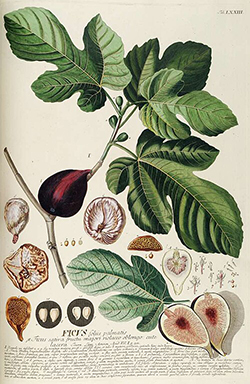
FICUS CARICA
MORACEAE
The fig tree is probably the best-known and most appreciated representative of the Moraceae family.
Other Moraceae are also important: the breadfruit tree (Artocarpus altilis) and its cousin the tropical chestnut (Artocarpus altilis var. seminifera), the jackfruit (Artocarpus heterophyllus), mulberry trees, and the numerous ficus species, often large trees that sometimes strangle the trees they parasitize! Some Moraceae have a highly toxic latex (sap), such as Antiaris toxicaria.
The fig tree, Ficus carica, is native to Asia Minor or the Middle East. It spread very early on throughout the Mediterranean region, where the species was improved. Originally, the fig tree was a dioecious tree, with male trees (caprifigs) rarely producing quality fruit. Fertilization is complex and involves a small insect (Blastophaga psenes) which, while not present everywhere, has been introduced to many warm-climate countries.
Horticulturists have selected varieties that produce fruit (figs) without fertilization (parthenocarpic) and can be propagated by cuttings. This has allowed for the worldwide spread of this fruit tree in temperate and subtropical zones where Blastophaga is not found.
The fig tree is a small tree (less than 10 m tall), sometimes bushy. Its fairly large leaves are divided into several lobes (3 to 5) and die back in winter.
All parts of the tree contain a white latex that flows spontaneously when the bark is cut, a branch is pruned, or a leaf is removed. This latex is not caustic but can cause inflammatory skin reactions, even burns.
The fruit, the fig, is actually a fleshy receptacle (syconium) containing numerous tiny seeds, which are minuscule and infertile in parthenocarpic varieties.
When ripe, the fig, which is greenish-yellow to brown or purple, softens and then falls from the tree.
The inside of the fig is often colored by red or purple anthocyanins.
The fig tree is therefore an important fruit tree but also a medicinal plant because of its latex, buds and leaves.
CHEMICAL COMPOSITION AND PROPERTIES
THE FIG FRUIT OF FICUS CARICA
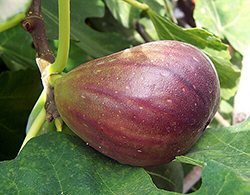
The fig is a fruit with a low water content and therefore dries easily, but it can also be eaten fresh (it does not keep for long).
Average chemical composition per 100 g:
FRESH FIGS : 75 to 80% water, approximately 17g of carbohydrates (glucose and fructose), 3 to 5g of fiber, very little protein and fat, some vitamins but in small quantities: vitamin C and B vitamins, especially B3 (niacin or vitamin PP), a significant amount of trace elements: calcium, iron, magnesium, phosphorus, and especially potassium.
100g of fresh figs provides approximately 70 kcal.
Figs contain anti-inflammatory and tissue-protective phenolic compounds: polyphenols, flavonoids, and anthocyanins, which color the inside of the fig a purplish-red.
Fresh figs also contain a small amount of latex, the composition and properties of which will be discussed later on this page.
DRIED FIGS : 100g of dried fig provides 250 kcal, 45-50g of sugars and about 10g of fiber, vitamin C is gone, but not the other vitamins, trace elements and protective phenolic compounds.
The fig is an easy-to-digest fruit that promotes intestinal transit and is quite high in calories once dried, but its vitamin C content is low.
THE LEAVES AND BUDS OF FICUS CARICA
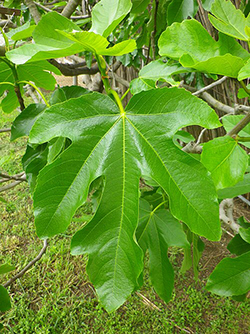
Fresh or dried fig leaves contain numerous compounds with a phenolic structure that are known:
For their ability :
– to limit the inflammatory response and the risk of infection,
– the effects of type 2 diabetes (anti-diabetic properties),
-the effects of free radicals (antioxidant effect).
– They boost immunity (especially against viral infections).
– They also have healing properties and seem capable of curing certain forms of gastritis and perhaps stomach ulcers.
FICUS CARICA LATEX
Latex is present in all parts of the tree and exudes when the leaves are crushed or the bark is notched or the small branches are cut.
Latex is a skin irritant; some people are very sensitive to it and can develop skin reactions resembling a burn.
This highly inflammatory reaction is due to the presence of furocoumarins (psoralen and bergapten), which are photosensitizing compounds, especially in humid environments. Exposure to light transforms these coumarins into products capable of damaging the DNA of cells (photodermatitis).
Furthermore, the latex contains ficin, a proteolytic enzyme (which breaks down proteins), with mild anti-inflammatory properties; it is often compared to papain from the papaya tree.
The raw latex, harvested by making incisions in the trunk, can be used to tenderize meat (similar to papain).
People allergic to natural rubber (latex from the rubber tree) should be wary, as there may be a cross-allergic reaction.
RECENT RESEARCH ON THE PHARMACOLOGICAL PROPERTIES OF FICUS CARICA
The fig tree is a medicinal plant that has been somewhat forgotten in Europe. Nevertheless, pharmacology researchers in the Middle East, China, and India are interested in Ficus carica.
They are primarily studying the positive effects of fig extracts on diabetes, high blood pressure, metabolic syndrome related to overweight, gastrointestinal disorders, and even the skin manifestations of atopic dermatitis.
Several pharmacology articles (in Asia) demonstrate the potential use of fig extracts applied as a topical cream to alleviate atopic dermatitis or as a skin lightener.
To my knowledge, there are no such products available in European pharmacies.
The positive effects of latex on the evolution of gastroduodenal ulcers are also being studied in India.
USES
THE FIG: A DIETARY AND NOURISHING FRUIT
Figs are a fruit that can be harvested in early summer and also in autumn, for bifera varieties that produce two crops.
They are eaten raw; they aid digestion and intestinal transit, and provide trace elements, vitamins, and phenolic compounds that protect tissues.
Since they don’t keep for long, they make excellent preserves and jellies.
Once dried, it’s a nutritious food that keeps very well, like dates, prunes, or apricots. Its fiber content promotes intestinal transit in cases of chronic constipation, but its calorie content must also be considered.
Dried or fresh figs can also be used in pastries or to flavor yogurts.
LATEX LEAVES AND BUDS OF FICUS CARICA
– Proteolytic latex can be applied to small warts. Collected by incisions in the trunk and branches, then dried and pulverized, it can be used to coagulate milk in the absence of rennet. It is also a source of proteases.
– Leaf infusion: Fresh or dried leaves can be used, prepared like tea.
Place a handful of fresh leaves in half a liter of water, bring to a boil for one minute, then let steep for a few minutes.
This is a beneficial beverage for respiratory viral infections, minor digestive issues (dyspeptia, gastritis), and can also be used in conjunction with antihypertensive or antidiabetic medication.
Once cooled, this infusion can be applied to patches of eczema or, with caution, to atopic dermatitis.
– The French school of gemmotherapy recommends fig buds glycerine macerate for controlling gastroduodenal ulcers. Modern treatment with proton pump inhibitors and antibiotics against Helicobacter pylori is more effective, but some gastric ulcers are not always accompanied by this bacterial infection.
Dosage:
Ficus carica buds, 1D glycerine macerate: 50 to 100 drops daily for initial treatment and for 20 days per month for prolonged treatment.
This treatment can be combined with more modern therapies.
In cases of dyspepsia or mild gastritis: 50 drops daily.
– Fresh or dried leaves can be used as fodder.
FIG TREE CULTIVATION
The fig tree is native to Asia Minor. It tolerates drought, high temperatures, and short periods of frost (down to -10/-15°C), making it very well-suited to countries with a Mediterranean climate: the Mediterranean region, the Middle East, India, Pakistan, certain regions of the Americas, and Australia.
Some varieties can withstand colder and more humid climates.
It is not adapted to very humid tropical and equatorial regions, but some varieties thrive in the limestone atolls of the Pacific (Tuamotous).
Propagation is possible by seed, but the results are unpredictable and slow.
Propagation by cuttings is easy and quick (3 years to obtain the first figs under good growing conditions).
There are numerous varieties.
The fig tree is undemanding and disease-resistant.
In 2024, global production of fresh figs was estimated at 1.34 million tonnes (with Turkey being the leading producer at that time).
SOME OTHER FIG TREES
Many species of fig trees are large trees whose fruits are eaten by birds or monkeys, let us mention two fig trees whose fruits are edible.
The sycamore fig (Ficus sycomorus) is native to sub-Saharan Africa. It is not found in very wet and hot regions, but it is naturalized in Egypt and the Arabian Peninsula. It is a tree that can reach a considerable size, has abundant foliage, and produces small (2-3 cm) edible fruits. Its leaves can be used as fodder. It can be propagated by cuttings.
The Mayan nut, or breadnut (Brosimum alicastrum), is not a walnut tree but a member of the Moraceae family, likely originating in Central America and introduced to the Greater Antilles. It has many common names. In Spanish, it is called Ramón, and in Haitian Creole, it is known as NOIX PAIN or chokogou.
Its small fruit is a kernel surrounded by a thin, fragrant skin. The kernel was consumed by the Maya, and forest animals relish it.
This tree is considered a good species for reforestation. It also has the unique characteristic of being a dual carbon sink (cellulose and lignin, plus calcium carbonate). It tolerates poor, degraded, and even slightly saline soils. It grows in well-watered tropical zones but also withstands drought thanks to a highly efficient network of fungi associated with its roots.
Copyright 2026: Dr jean-Michel Hurtel
Website dedicated to the knowledge of medicinal plants and essential oils